Exploring the Future: Inside the Quantum Computing Revolution
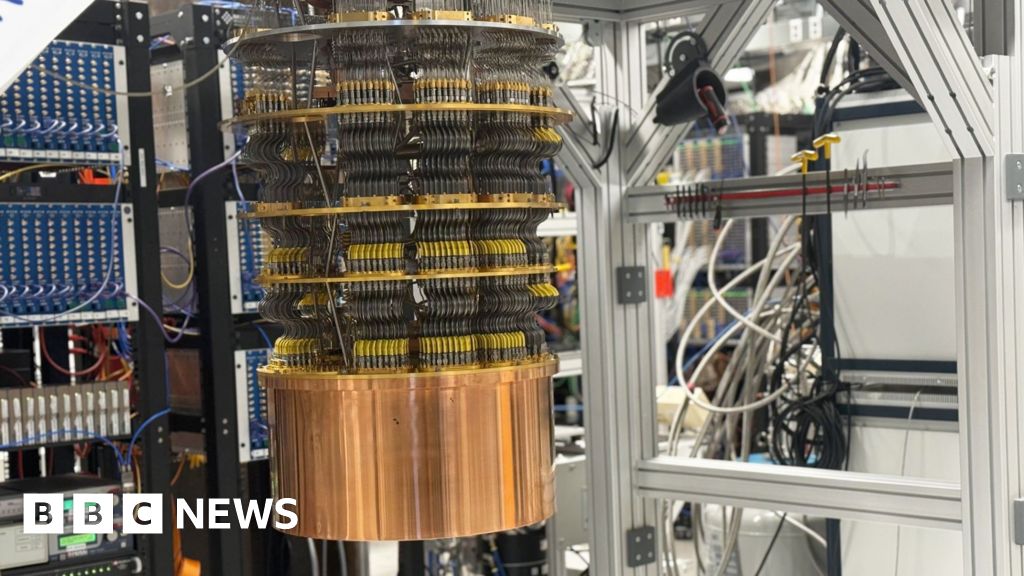
Resembling a golden chandelier, this marvel houses the coldest spot in the universe.
Before me stands not just the world’s most powerful computer, but a pivotal technology influencing financial security, Bitcoin, government secrets, and the global economy.
Quantum computing is the key to determining which nations and corporations will dominate the remainder of the 21st century.
Suspended a meter above the ground in a Google lab in Santa Barbara, California, is Willow. It defies expectations.
Absent are screens or keyboards, let alone futuristic headsets or brain-interface chips.
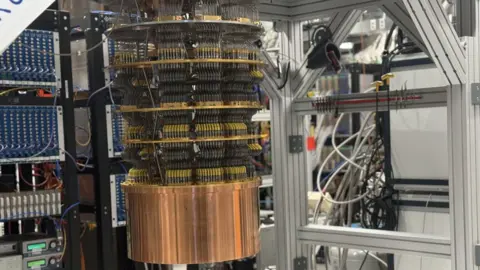
Willow consists of a series of circular discs, akin to an oil barrel, linked by numerous black wires descending into a bronze liquid helium bath, maintaining the quantum chip at a fraction above absolute zero.
Its appearance is reminiscent of the 1980s, yet if quantum’s potential is realized, this metal and wire structure could revolutionize the world.
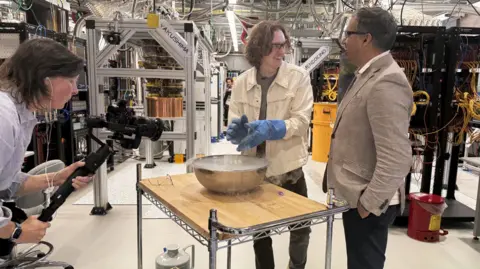
“Welcome to our Quantum AI lab,” greets Hartmut Neven, Google’s Quantum chief, as we pass through the secure entrance.
Neven, a legendary figure blending technological brilliance with a passion for techno music, dresses as if he’s just snowboarded from the Burning Man festival, where he designs art. Perhaps, in a parallel universe, he has.
His mission is to transform theoretical physics into practical quantum computers “to solve otherwise unsolvable problems.” He admits his bias but claims these chandeliers are the world’s best performers.

The Secretive World of Quantum Science
Our discussion often revolves around what cannot be filmed in this restricted lab. This crucial technology is under export controls and secrecy, central to a race for commercial and economic dominance. Even minor advantages, from component designs to global supply chain companies, offer potential leverage.
A distinct Californian vibe permeates this high-tech sanctuary, with its art and vibrant colors. Each quantum computer bears a name like Yakushima or Mendocino, wrapped in contemporary art, with graffiti-style murals adorning the sunlit walls.
Neven showcases Willow, Google’s latest quantum chip, which has achieved two significant milestones. He claims it conclusively settled the debate on whether quantum computers can perform tasks beyond classical computers.
Willow also solved a benchmark problem in minutes that would have taken the world’s best computer 10 septillion years, a number with 25 zeros, surpassing the universe’s age.
This theoretical breakthrough was recently applied to the Quantum Echoes algorithm, impossible for conventional computers, aiding in molecular structure analysis using MRI technology.
Neven lists potential applications for the Willow quantum chip, stating it will “address many of humanity’s current challenges.”
“It will enable more efficient drug discovery,” he explains. “It will enhance food production, energy generation, transportation, and storage, tackling climate change and global hunger.”
“It allows us to better understand nature, unlocking secrets to develop technologies that improve life for everyone,” he adds.
Some researchers believe true Artificial Intelligence will only be achievable with quantum computing.
Team members recently received the Nobel Prize for pioneering research into “superconducting qubits” used here.
The Willow chip boasts 105 qubits. Microsoft’s quantum initiative has 8 qubits, employing a different approach. The global race is to reach 1 million qubits for a “utility-scale machine” capable of error-free quantum chemistry and drug design. The technology remains delicate.
The world closely monitors developments here. Professor Sir Peter Knight, Chair of the National Quantum Technology Programmes Strategy Advisory Board, notes Willow’s groundbreaking achievements.
“All machines are still in the experimental stage, prone to errors. They require error correction. Willow was the first to demonstrate error correction through repeated repairs, improving over time,” he explains.
This positions the technology to scale towards performing a trillion operations accurately, potentially within seven or eight years, rather than the previously assumed two decades.
If the early 21st century was defined by the internet and Artificial Intelligence, the next 25 years will undoubtedly mark the dawn of the Quantum era.
Understanding Quantum Mechanics
Imagine searching for a tennis ball in one of a thousand closed drawers. A classical computer checks each one sequentially. A quantum computer opens them all simultaneously. Similarly, instead of needing a hundred keys for a hundred doors in traditional computing, quantum allows you to unlock all with a single key, instantly.
These machines won’t be for everyone. They won’t shrink into phones, AI glasses, or laptops. However, their power grows exponentially, and everyone is joining the race.
I ask Nvidia chief Jensen Huang if this threatens his model of providing specialized AI chips. “No, a quantum processor will complement future computers,” he responds.
A UK leader in the field highlights the stakes in the quantum realm-the potential to decrypt almost anything, from state secrets to Bitcoin.
“Cryptocurrency will also need reevaluation due to the quantum computing threat,” Sir Peter states.
A top Nvidia partner last year suggested that while Bitcoin has a few years left, the technology must evolve to a stronger blockchain by the decade’s end.
Tech industry insiders refer to “Harvest Now, Decrypt Later,” describing how state agencies are believed to be storing encrypted data globally, anticipating future access.
The Global Quantum Race
Then there’s the worldwide race. China’s approach differs significantly from the commercial race in the US and the West.
With around $15 billion (£11 billion) invested, China’s commitment to quantum technology rivals the combined efforts of other global government programs, according to Sir Peter.
Since 2022, China has published more quantum research papers than any other country, led by pioneering physicist Pan Jianwei. It’s a key component of Beijing’s 14th five-year plan.
China decided to centralize quantum research, halting tech giants like Baidu and Alibaba from independent development, focusing resources on a state-run enterprise. China aims to lead in quantum communications and satellites.
Last year, Jianwei developed and tested the Zuchongzhi 3.0 quantum computer using similar technology but a different approach than Willow, claiming comparable results. It was opened for commercial use in the fall. It feels reminiscent of the World War II Manhattan Project or the 21st-century Space Race.
The UK is a scientific hub for quantum research. A British scientist pioneered superconducting qubits. Numerous companies and cutting-edge research thrive here. The government plans significant investment in the coming weeks. It’s crucial for economics, military use, and geopolitics. The UK aspires to be the third power in this field.
Exploring Parallel Universes
Back at the Willow lab, existential questions arise. Last year, Neven suggested Willow’s unprecedented speed supported some theories of a multiverse. Essentially, this speed could be explained by Willow tapping into parallel universes for computing power. Not all scientists agree.
“There’s still a spirited debate,” he tells me. “As you learned during your lab visit, quantum computers’ power lies in touching 2 to the 105 combinations simultaneously within one clock cycle. It raises questions about these different possibilities… There’s a version of quantum mechanics to consider-the many-worlds interpretation-parallel universes or realities.”
Neven clarifies that Willow hasn’t proven this but suggests “we should take this idea seriously.”
This is the cutting edge of global technology and growth, and the British Government will soon invest hundreds of millions to catch up with Willow and China. It sounds like science fiction, but it’s rapidly becoming economic reality.
